A Research-Based Exploration · Fashion, Feminism & Sociological Theory · 1940s–2020s
Dressed for the Revolution:
How war, liberation, power, and resistance shaped what women wore, and in turn, how what women wore shaped history. The why behind how the same garments keep returning, and what that tells us.
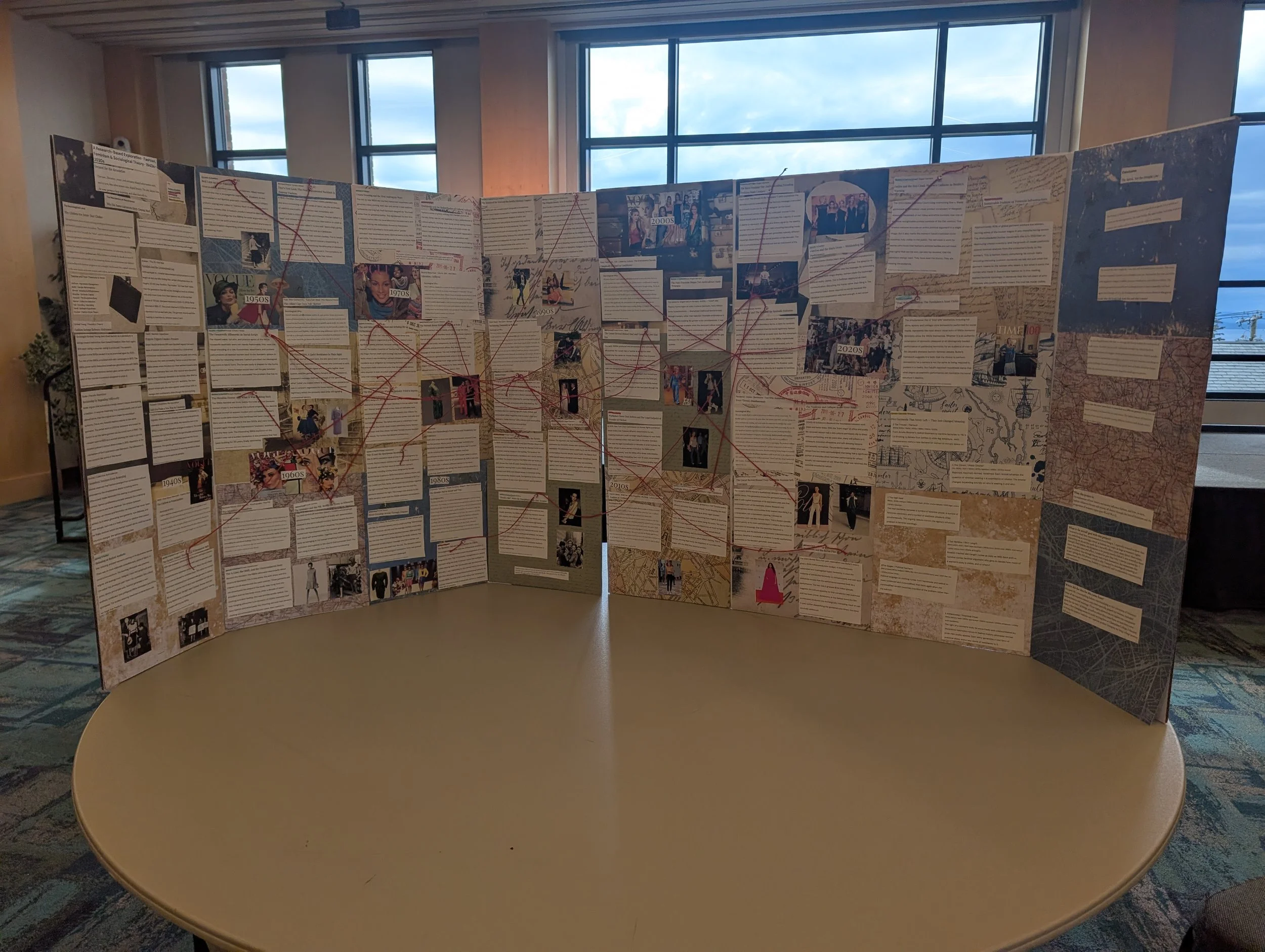
*The finished written portion of my senior capstone project that designed and designated the topic of, spending a semester researching and drawing connections with trends and their cause and effect. On the day we presented, I showed these connections with yarn for each relating point as shown below:
The Sociological Lens
Why Clothes Are Never Just Clothes
This exploration draws on intersecting sociological frameworks to explain why fashion and feminist progress move in tandem. These theories appear both throughout each decade as the "why" beneath the "what", and in a dedicated section explaining why particular garments and battles keep reappearing across time.
Theories and Their Theorists to Note:
Goffman · Impression Management
Butler · Gender Performativity
Simmel · Imitation & Differentiation
Bourdieu · Symbolic Capital
Foucault · The Disciplined Body
Blumer · Collective Selection
Hall · Encoding / Decoding
Faludi · Backlash Hypothesis
Kroeber · Fashion Cycle Theory
Fashion has never been frivolous. For women, the hemline, the silhouette, the fabric, the slogan have all been political acts. What follows is a decade-by-decade account of that negotiation and crucially, of the recurring themes that demonstrate that fashion's relationship with feminist progress is not a straight line forward, but a spiral: returning to the same battles with new context, new stakes, and new meaning each time.
Society → Fashion
Fashion → Society
Bidirectional
Sociological Why
Cross-Decade Thread
The Mechanics of Recurrence
Why the Same Garments Keep Coming Back
Fashion does not evolve in a straight line. Sociologists and trend theorists have identified several overlapping mechanisms that explain why the same garments, debates, and political battles reappear across decades, each time wearing the same shape but carrying new weight. Understanding these mechanisms transforms fashion history from a series of aesthetic shifts into a map of recurring social struggle.
Kroeber / The 20-Year Rule
Nostalgia and the Generational Lag
Anthropologist A.L. Kroeber documented cyclical patterns in skirt length as early as 1919, finding that certain silhouettes recur on roughly 20–50 year rhythms. The modern "20-Year Rule" holds that the generation that did not live through a trend as children, who only know it only from ‘their parents' era, is the one that revives it. Y2K low-rise jeans returned in 2020–22. 1970s flares returned in 2015–17. The corset returned in 2020s fashion not as oppression but as aesthetic play. The garment returns and the meaning is rewritten by whoever wears it next.
Kroeber, On the Principle of Order in Civilization (1919) · Breakell, Trendalytics (2022)
Kimball Young / Pendulum Theory
Fashion Swings Between Extremes
Sociologist Kimball Young described fashion as a pendulum. It swings toward restriction, then toward freedom, then back again. With each swing a counter-swing is produced. The corset's rejection in the 1920s caused it to be promoted again by 1930. The mini of the 1960s provoked midi-skirt campaigns in 1970. The 1980s power suit's masculine broadness generated the soft 1990s waif aesthetic. Each feminist fashion gain carries within it the seed of the counter-movement designed to undo it.
Young, Social Psychology (1930) · Faludi, Backlash (1991)
Faludi / Backlash Hypothesis
Progress Triggers Counter-Pressure
Susan Faludi's landmark 1991 work Backlash argued that each wave of feminist advancement is followed by a cultural and institutional counterreaction, not because the goals were wrong, but because they were succeeding. Fashion is one of the most visible arenas where this plays out. After wartime trousers came Dior's hyper-feminine New Look. After second-wave liberation came power dressing's demands to de-feminize. After #MeToo came modesty-policing and "trad wife" aesthetics. The more ground women gain, the more urgently certain forces work to restage their confinement, often through the form clothing.
Faludi, Backlash: The Undeclared War Against American Women (1991)
Butler / Parodic Repetition
Reclaiming by Repeating Differently
Butler argues that subversive change doesn't require abandoning a tradition , it requires inhabiting it so conspicuously, and on such altered terms, that the original norm loses its naturalized authority. This is why feminist fashion returns to the same garments. The corset worn in 2023 by someone who knows its history is not the same garment as the corset worn in 1890. The miniskirt worn in 1960 by a woman claiming her body is not the miniskirt policed in school dress codes in 2010. Repetition is the mechanism of both oppression and liberation. The difference is who controls the terms of the repeat.
Butler, Gender Trouble (1990)
Foucault / Disciplinary Re-inscription
Each Era Finds a New Way to Constrain
Foucault argued that disciplinary power does not disappear, it migrates. When one form of bodily control becomes politically untenable (the corset in the 1920s, the restrictive skirt in the 1970s), a new form of discipline emerges to replace it. The corset becomes the rigid shoulder pad. The rigid shoulder pad becomes the obligation to be thin. The thin ideal becomes the fitness imperative. The specific garment or beauty standard changes, though the underlying structure of requiring women to shape their bodies to social approval persists.
Foucault, Discipline and Punish (1975) · The History of Sexuality (1976)
Simmel / Collective Ambivalence
Unresolved Tensions Keep Resurging
Simmel observed that fashion emerges from unresolved cultural ambivalence, the simultaneous desire to belong and to differentiate. Kaiser extended this stating in a postmodern context, fashion proliferates precisely because the underlying social tensions are never resolved. The tension between femininity-as-chosen and femininity-as-imposed has never been settled. So it keeps generating new garments, new debates, and new revivals. Each one is a fresh attempt to resolve what cannot be finally resolved within the fashion system alone. Until the social structure changes, the fashion debate cycles.
Simmel, Philosophy of Fashion (1905) · Kaiser, Fashion, Postmodernity and Personal Appearance (1991)
Cross-Decade Threads
Five Garments That Never Left — They Just Changed Meaning
The Trouser / Pantsuit
1850s| 1940s | 1960s | 1970s | 1980s | 1990s | 2020s
From Amelia Bloomer's radical bloomers to wartime factories to YSL's Le Smoking to Senate floor battles to wide-leg athleisure, each reappearance marks a new demand for women to occupy space on their own terms.
The Corset / Waist Cincher
Pre-1920s | 1947 | 1950s | 1970s rejection | 1990s | 2020s revival
Rejected, mourned, revived, reclaimed. Each revival reframes the question of whether wearing it is submission or choice. The answer changes depending entirely on who is wearing it and why.
The High Heel
1950s | 1970s critique | 1980s power heel | 2000s choice debate | 2015 legal reform | 2020s rejection
The heel oscillates between a symbol of feminine power, a symbol of feminine restriction, and a symbol of aesthetic pleasure, often simultaneously. The ongoing debate mirrors the agency-structure problem in feminist sociology.
The Hemline / Skirt Length
1940s utility short | 1947 maxi backlash | 1960s mini | 1970s midi | 1990s mini revival | 2010s micro-mini | 2020s all lengths
Kroeber tracked skirt length cycles as early as 1919. Each shift in hemline carries feminist argument: who gets to decide how much of a woman's body is visible, and to whom?
The Slogan / Political Garment
1968 protest| 1970s badges | 1990s Riot Grrrl skin | 2000s ironic tees | 2017 Dior tee | 2020s protest dress
Political language on clothing cycles from handmade and radical to mass-produced and commodified, then back again when the commodified version becomes a symbol of the problem rather than the solution.
Athleticwear / Practical Dress
1940s factory wear | 1970s sportswear | 1980s aerobics | 2000s athleisure | 2020s post-pandemic
The right of a woman's body to move freely and unencumbered by decorative restriction recurs in fashion history whenever women enter new public spaces. Each entry generates a new form of practical dress, and a new round of resistance to it.
1940s
WWII · First Wave Aftermath · Factory Floor
The Uniform as Emancipation
Sociological Why
Goffman's impression management explains wartime fashion as a renegotiation of social categorization, in this case, women dressing for the factory were forcing society to recognize a new role. Foucault's disciplined body makes the Dior counter-reaction at the end of the war and the decade intelligible. When one regime of bodily control (corset and skirt) is disrupted, the system works to re-inscribe another. The debate between the utility silhouette and the New Look is not an aesthetic disagreement, it is a power struggle over what the female body is permitted to signal.
Goffman (1959) · Foucault, Discipline and Punish (1975)
Society → FashionThread: Trouser
The Factory Trouser: Practical Claim, Permanent Shift
With men overseas, women entered factories and heavy industry. Skirts were physically incompatible with machine operation, and trousers became necessary and standard. When the war ended, many women refused to surrender them. This marks the moment the trouser transitions from borrowed male garment to claimed female one, and the first of many such transitions over the next 80 years. However, the fight wasn't finished. Women were still being denied entry to restaurants, hotels, and courts for wearing trousers well into the 1970s.
Thread continues: 1970s pantsuit, 1993 Senate floor, 2020s wide-leg
Society → Fashion
Rationing as Radical Aesthetic
War rationing stripped women's clothing of its decorative excess. There was no more elaborate embellishment, yards of fabric, or constrictive structure. The resulting silhouette was practical, angular, and androgynous. Designer Claire McCardell built what she called "the American Look" from this constraint. She utilized jersey, denim, and simple cuts. Scarcity generated a new aesthetic vocabulary that prefigured 1960s minimalism and 1970s sportswear. The bodies rationing freed from ornamentation did not forget that freedom.
Society → Fashion
Red Lips as Anti-Fascism
Hitler publicly scorned cosmetics on women. Allied women turned this into a propaganda opportunity. Elizabeth Arden formulated a red lipstick precisely matching women's military uniform piping and called it ‘Victory Red’. It was distributed in women’s military kits. A beauty product became ideological opposition. This prefigures the 1990s feminist argument that cosmetics can be both a tool of patriarchal control and a site of self-determination depending entirely on who controls the terms of wearing them.
Thread connects: 1990s third-wave "lipstick feminism"
BacklashThread: Corset / Waist
Dior's New Look: The First Documented Backlash in Postwar Fashion
In 1947, Christian Dior presented cinched waists, padded hips, and skirts consuming up to 20 yards of fabric, aka the antithesis of wartime practicality. The reaction was immediate, with protests held in cities like London and Chicago. Women called it a "sack" and refused to buy it. Carmel Snow, then editor-in-chief of Harpar’s Bazzar, famously called it "a new look" approvingly, giving the style its name. Others saw the look as a deliberate reassertion of male authority over women's bodies. This is Faludi's backlash made couture — the fashion industry responding to women's wartime gains by reinscribing the silhouette of domestic femininity. And yet many women still loved it. The complexity of that "and yet" runs through every decade that follows.
Thread continues: 1950s housewife silhouette, corset revivals
1950s
Post-War Conformity · Suburban Ideal · Pre-Second Wave
The Gilded Cage Goes Full-Skirted
Sociological Why
Simmel's imitation and differentiation explains the 1950s paradox: women were handed a uniform of domestic femininity that emphasized conformity to a prescribed social role which imitated the ideal housewife. Meanwhile Bourdieu's symbolic capital clarifies the stakes: the well-dressed housewife accrued social legitimacy within the only field formally available to her. Deviation meant social illegibility. Goffman's front-stage performance captures the costume and role as so thoroughly entwined that a generation internalized the performance as identity until Friedan named the gap between the costume and the inner life it concealed.
Simmel (1904) · Bourdieu (1984) · Goffman (1959) · Friedan, The Feminine Mystique (1963)
Society → FashionThread: Corset / Waist
The Housewife Silhouette as Social Script
The nipped waist, full skirt, and pristine apron of the 1950s housewife aesthetic were not merely fashionable, they were the visual encoding of a role. Economists, advertisers, and postwar policymakers all needed women back in the domestic sphere to free jobs for returning veterans. Fashion provided the ideological argument in fabric form. The female body is shaped for the home, not the factory. Betty Friedan would later call the gap between this costume and the lives it concealed "the problem that has no name."
Thread connects: 1947 New Look → 1960s rejection of full skirt
Fashion → Society
The Pencil Skirt, A Quiet Resistance in Plain Sight
Alongside the full-skirted norm, the slim pencil skirt, a wartime office remnant, persisted among women who continued to work. It was a subtle counter-signal within a highly legible visual system, and this garment held a forward-facing, professional, purposeful message. Goffman's concept of the "generalized other" (what you expect others to think of a given appearance) was in constant negotiation for these women. They maintain legitimacy within the domestic ideal while still signaling professional identity.
Society → FashionThread: Hemline
The Hemline Freeze and What It Was Holding Back
The 1950s hemline sat firmly below the knee and not because women chose it, but because the cultural project of the decade required women to appear modest and contained. Kroeber's fashion cycle data shows that hemlines had been rising since 1844, were at their highest in the late 1920s, and were forcibly lowered again through the Depression's "modesty" aesthetic and then the New Look. The impending 1960s explosion of the miniskirt was not a sudden revolution, it was pressure that had been building for 20 years, finally detonating.
Thread continues: 1960s miniskirt, 1970s midi wars, 1990s micro-mini
1960s
Second Wave · Civil Rights · Youthquake · The Pill
The Miniskirt as Manifesto
Sociological Why
The 1960s are a textbook case of Simmel's trickle-up theory, aka fashion change originating not from elite couture but from street-level subcultures, inverting centuries of cultural authority. Butler's gender performativity reaches its first mass expression here as the miniskirt acts as a refusal to perform modesty, containment, and spatial deference. But the 1960s also introduced a key complication: the fashion industry, sensing commercial opportunity, rapidly absorbed and commodified the subcultural challenge. When Mary Quant's street aesthetic reached Vogue and department stores, its subversive edge was monetized. This cycle of subversion-into-commodity is one fashion repeats in every decade.
Butler (1990) · Simmel (1904) · Sproles, Trickle-Up Model (1985)
BidirectionalThread: Hemline
The Miniskirt and the Pill, Bodily Autonomy as Silhouette
The birth control pill and Mary Quant's miniskirt arrived almost simultaneously. Two technologies of bodily self-determination released in the same cultural moment. Neither caused the other, but they reinforced each other's meaning. The pill gave women control over reproduction while the miniskirt gave women control over visual self-presentation. Together, they reframed the female body as belonging to the woman inhabiting it, and not to the institution, the husband, or the church that surrounds them. The hem rising is inseparable from the liberation accelerating.
Thread connects: 1950s hemline freeze → 1970s midi-skirt backlash
Society → FashionThread: Athleticwear
The A-Line, the Shift, and the Unencumbered Body
Beyond the miniskirt, the 1960s silhouette was broadly about structural liberation: the A-line dress, the shift dress, and the trapeze cut all abandoned the waist entirely. These garments did not accentuate the shape of the body, they hung from the shoulders and let the body move. After a decade of waist-cinching and skirt-belling, this was architecturally radical. The free-hanging silhouette is an ancestor of 2020s oversized and boxy fashion and showcases the recurring demand that women's clothing accommodate movement rather than restrict it.
Thread connects: 1940s utility → 1970s sportswear → 2020s post-pandemic comfort
Society → Fashion
Unisex Dressing and the First Androgyny Wave
The mid-to-late 1960s saw the first mainstream experiment with genuinely unisex clothing. Both men and women in bell-bottoms, turtlenecks, and long hair. Rudi Gernreich designed for "the body" rather than for gendered bodies. This represented the first time in modern fashion that the visual distinction between men's and women's clothing was deliberately blurred by mainstream designers, and it provoked a moral panic about "gender confusion" that foreshadows nearly identical panics in the 1990s and 2010s. The visual argument for gender fluidity has been made in fashion repeatedly and each time it advances slightly further.
Thread connects: 1970s androgyny → 1990s grunge → 2010s gender-neutral fashion
Fashion → Society
Youthquake and the Redistribution of Cultural Authority
Fashion's center of gravity shifting from Parisian couture to Carnaby Street was not only aesthetic, it was a redistribution of cultural authority. Working-class young women setting trends rather than inheriting them from elites is Simmel's trickle-up theory made sociologically visible. The same shift happened in music, film, and politics simultaneously. A generation was\ refusing to receive culture from above and insisting on making it themselves. Fashion was both a reflection and an accelerant of this redistribution.
The pendulum of fashion swings its curious measure. Each feminist fashion gain carries within it the seed of the counter-movement designed to undo it. The question is never whether the backlash will come, only how it will be dressed.
1970s
Second Wave Peak · Title IX · ERA · Midi Wars
Liberation, Unfiltered
Sociological Why
Blumer's collective selection theory explains the decade's radical pluralism: when a movement reaches critical mass, it breaks the previous norm's monopoly on "acceptable." The 1970s produced no single dominant female silhouette because the feminist movement had successfully destabilized the premise that one should exist. Meanwhile, the pantsuit boom illustrates Bourdieu's symbolic capital transfer at scale, in which women appropriated the authority encoded in the suit and refused to let it remain gender-exclusive. Critically, YSL's 1966 Le Smoking trouser suit had already laid the couture groundwork. What the 1970s added was mass adoption driven by social movement, not trend cycles.
Blumer (1969) · Bourdieu (1984) · YSL Le Smoking (1966)
Society → Fashion
The 1968 Miss America Protest and Refusing the Performance
The "Freedom Trash Can" into which protesters threw bras, girdles, and beauty magazines is one of fashion history's most significant events, precisely because nothing was actually burned. The media's invention of "bra burning" (coined to evoke the image Vietnam draft-card burning) was itself a backlash tactic where it was trivializing a serious critique of beauty standards as an obligation by comparing feminists to traitors. The protest made a structural point that the garments women were required to wear encoded judgments about women's social value that women had not consented to.
Thread connects: 2011 SlutWalk — both use clothing refusal as political argument
BidirectionalThread: Trouser / Pantsuit
The Pantsuit Boom: Symbolic Capital at Scale
The 1970s pantsuit was not merely practical, it was the mass appropriation of what Bourdieu would call the symbolic capital of the suit and its centuries-long associations with authority, rationality, and public competence. As women entered law firms, newsrooms, and government offices, they dressed in the visual language of those spaces. This was strategic impression management at a generational scale where a whole cohort of women recalibrated their front-stage performance for new stages that had not been designed for them. Harrods had only allowed women in trousers into its store in 1970.
Thread connects: 1940s factory trouser → 1980s power suit → 1993 Senate floor
Society → FashionThread: Hemline
The Midi-Skirt Wars: When the Industry Tried to Impose Modesty
In 1970, designers and retailers, led by the Paris couture industry, attempted to dramatically lower hemlines in the so-called "midi war." Women largely refused to buy. Sales of midi skirts were catastrophically poor and the fashion industry lost millions. For the first time, women's collective consumer power overrode what the industry dictates. The failed midi push is a landmark. It was the moment the trickle-down model definitively broke. Women would wear what they chose, not what Parisian houses decided they should. The hemline had become autonomous.
Thread connects: 1947 New Look imposition → 1970s consumer refusal → 2020s multi-length pluralism
Bidirectional
Diane von Fürstenberg's Wrap Dress and Femininity for Feminists
DVF's 1974 wrap dress was significant precisely because it was not the pantsuit. Where power dressing said "minimize your femininity to be taken seriously," the wrap dress said "a woman can be feminine and professionally capable, and that combination is not a contradiction." DVF herself called it a dress for women who didn't need to ask permission. By 1976, it had sold five million units. It offered a different answer to the same question the pantsuit was asking: how does a woman dress for a world that wasn't built for her?
Society → FashionThread: Athleticwear
Title IX and the Sportswear Revolution
Title IX (1972) mandated equal access to sports programs for women. Sports require clothes that allow the body to perform. The decade saw the first wave of mainstream women's sportswear including running shoes designed for female biomechanics (a genuine 1970s innovation), athletic shorts, and the first rudimentary sports bra which was invented in 1977 by Lisa Lindahl and Polly Smith, who sewed two jockstraps together. The right to move freely in a public sport was new and the garments followed the right. This lineage runs directly to the 1980s aerobics boom and the 2020s athleisure normalization.
Thread connects: 1940s factory wear → 1980s fitness boom → 2020s post-pandemic comfort
1980s
Corporate Feminism · Power Dressing · Reagan · New Contradiction
The Shoulder Pad as Armor and Trap
Sociological Why
The 1980s are the clearest case of Goffman's dramaturgical model applied to feminist strategy and its limits. Power dressing was rational impression management for a hostile front stage aka the professional office. But it also illustrates the contradiction at the heart of liberal feminism's fashion strategy: gaining access by making yourself acceptable to the gatekeepers, rather than changing the gate. Bourdieu's symbolic violence is at work here., that women were absorbing the judgment that their natural presentation was professionally illegitimate and adjusting accordingly, which reinforced rather than challenged that judgment's authority. Faludi identifies this decade as the height of the backlash with the Equal Rights Amendment ratification failing in 1982, Reagan dismantling social programs, and the fashion industry responded with a silhouette that demanded women de-feminize themselves for permission to enter.
Goffman (1959) · Bourdieu, Masculine Domination (1998) · Faludi (1991)
BidirectionalThread: Trouser
Power Dressing: Access Through Disguise
John Molloy's Dress for Success told women to wear skirted suits with ties, to minimize jewelry, and to avoid anything "distractingly feminine." Women did this and the strategy worked, measurably. Women in management nearly doubled between 1980 and 1987. But the cost was a form of Bourdieusian symbolic violence. The professional world's implicit message was that a woman was acceptable when she didn't look like one. The decade's fashion success was also an ideological concession. Entry was granted and the terms of entry were not challenged.
Thread connects: 1970s pantsuit → 1993 Senate floor → 2000s workplace dress code reform
Fashion → Society
The Shoulder Pad and Space Claimed in Fabric
The exaggerated shoulder pad was architectural ambition. It broadened the female frame toward the proportions of a space designed for men. This is impression management as a spatial argument: using the body to occupy rooms that resisted the bodies entering them. But the shoulder pad also documents the absurdity it was responding to, that women had to structurally alter their silhouette to be permitted professional authority. By the late 1980s, feminist critics were noting that "dressing for success" required women to physically perform a masculinity they did not possess.
Society → FashionThread: Athleticwear
The Fitness Boom: New Freedom or New Discipline?
Jane Fonda's workout videos, aerobics classes, and the proliferation of gym culture introduced a new relationship between women and their bodies. Athleticwear moved into daily life with the sports bra (invented in 1977) becoming essential. This represented a genuine shift as the female body was framed as capable and performative rather than decorative. But Foucault's framework is critical here as the obligation to be fit replaced the obligation to be decorative without eliminating the underlying structure of requiring women to shape their bodies to social standards. The form of discipline changed but its intensity did not. This tension remains unresolved in 2026.
Thread connects: 1970s Title IX sportswear → 2000s athleisure → 2020s post-pandemic
Society → FashionThread: Hemline
The Return of the Mini and the Parallel Modesty Counter-Trend
The 1980s saw the miniskirt return alongside a simultaneous counter-trend toward conservative "modesty dressing" driven by the rise of religious conservatism. Reagan's America and Thatcher's Britain both saw political movements that explicitly connected women's dress to moral standards. The fashion industry produced both cuts simultaneously, the mini and the maxi, exposing and concealing, because the cultural ambivalence Simmel describes had deepened. No single silhouette could represent women in a decade when what women were "supposed to be" was contested more sharply than in any decade since the 1940s.
1990s
Third Wave · Riot Grrrl · Grunge · Postfeminism · Senate Trousers
Reclaiming Femininity as Weapon
Sociological Why
Third-wave feminism engaged Butler's performativity thesis in practice: if gender is performed through repeated acts, it can be re-performed differently. Riot Grrrl's parodic repetitions (reclaiming slurs on skin, wearing "feminine" dresses with combat boots) exposed the performed nature of the gender norms they inhabited , which is Butler's "gender trouble." Meanwhile, the decade also demonstrates the 20-Year Rule in ideological terms as the generation of feminists who came of age in the 1990s were the children of second-wave feminists, and they explicitly pushed back against their mothers' framework, not abandoning it, but revising it. The 1990s are also where fashion's relationship with feminism gets its deepest internal critique such that if wearing a mini-skirt can be feminist, can anything be feminist? And if anything can be feminist, does the word lose its meaning?
Butler (1990) · Kaiser et al. (1991) · 20-Year Rule theory
Society → Fashion
Riot Grrrl and The Body as Protest Sign
Emerging from punk scenes in Olympia, Washington, D.C., and London, Riot Grrrl used fashion as confrontation, including Doc Martens, ripped tights, babydoll dresses, and slurs written on skin. Writing "SLUT" on your arm is Butler's parodic repetition enacted physically and reclaiming the word by making its use conspicuous, chosen, and proud rather than shaming. The movement also self-consciously refused the fashion industry's mediation.Riot Grrrl clothing was DIY-made, thrifted, and personalized. When magazines tried to cover it, Riot Grrrl declared a "media blackout" with a refusal to be commodified that the industry found incomprehensible.
Thread connects: 1968 protest garments → 2011 SlutWalk → 2020s protest costume
BidirectionalThread: Slogan Garment
Third Wave Irony: Pink as Conscious Choice
Third-wave feminism reclaimed aesthetics the second wave had dismissed as patriarchal: pink, makeup, platform shoes, babydoll dresses. The argument was that femininity imposed by default is oppression but femininity chosen with awareness is self-expression. The distinction seems subtle but it was the decade's central fashion-feminist debate. Naomi Wolf's The Beauty Myth (1991) argued beauty standards were always disciplined. Camille Paglia argued women who embrace beauty are exercising agency. Both were right, in different registers, and neither fully resolved the tension that runs through every feminist fashion moment from the 1960s onward.
Thread connects: 1940s red lipstick → 2020s Barbiecore — the recurring debate about whether femininity can be claimed
Fashion → SocietyThread: Trouser
Pantsuits on the Senate Floor, 50 Years After the Factory
In 1993, Senators Barbara Mikulski and Carol Moseley-Braun wore pantsuits onto the Senate floor, forcing the chamber to lift its ban on women wearing trousers in the building. The Senate of the United States had maintained a mandatory skirt rule for women until 1993. The trouser's journey from 1940s mid-war factory to 1993 Senate floor took 50 years. During this time women were arrested for wearing them in court (1938), denied entry to Harrods (until 1970), and refused access to restaurant dining rooms across the Western world. The legislative victory was not a fashion moment, it was a civil rights moment wearing fashion's face.
Thread connects: 1851 Amelia Bloomer → 1940s factory → 1970s pantsuit boom → 1993
Society → FashionThread: Hemline
"Heroin Chic": When the Disciplinary Body Goes Invisible
After the 1980s demanded women be broad-shouldered and visually dominant, the 1990s demanded they become minimal: thin, angular, and undemanding of space. Kate Moss's waif aesthetic and the "heroin chic" that dominated high fashion were not just an aesthetic reaction, they were a Foucauldian regime shift. As women were gaining more institutional power (more senators, more CEOs, more professional athletes), the beauty standard calibrated in the opposite direction and toward a body that needed less space. The pattern is consistent: fashion's beauty ideal and women's institutional power tend to move in inverse relationship.
Thread connects: 1980s shoulder pad broadness → 1990s thinness → 2010s body positivity
–
"Fashion's beauty ideal and women's institutional power tend to move in inverse relationship. As women gain ground publicly, the body ideal shrinks. When ground is lost, the silhouette expands. The body is always the battlefield."
2000s
Post-Feminism · Y2K · Celebrity Culture · The Ambivalence Decade
Complexity Dressed as Confidence
Sociological Why
The 2000s illustrate Kaiser's cultural ambivalence model at its most acute: when there is no social consensus about what a woman should be, fashion produces a proliferation of competing styles, each attempting to resolve a tension that cannot be resolved through clothing. The decade also witnesses the 20-Year Rule as ideological nostalgia: Gen X designers and consumers revived 1980s elements (bold shoulders, power accessories) while simultaneously producing a truly unique hyper-femme Y2K aesthetic. Both were reaching back for certainty in a moment of confusion. Most significantly, the 2000s introduced the agency-structure problem as a mainstream debate. When Paris Hilton wears revealing clothing, is it feminist self-expression or the male gaze internalized? The debate remains open because the question is genuinely undecidable.
Kaiser (1991) · Wolf, The Beauty Myth (1991) · 20-Year Rule
Society → FashionThread: Slogan Garment
The Post-Feminist Slogan Tee: Ambivalence Made Wearable
The celebrity slogan tee of the early 2000s — "DUMP HIM," Playboy bunny logos on Juicy Couture tracksuits, Paris Hilton's ironic hyperfemininity — dramatized traditional feminine roles through mockery rather than rejection. Wearable ambivalence is inhabiting and mocking the gender script simultaneously. It was the only language available when the dominant culture insisted that feminism was over and unnecessary, yet women could still see (and feel) the inequality around them. The irony was the gap between the official story and the lived reality, worn on the outside.
Thread connects: 1990s Riot Grrrl irony → 2017 luxury feminist tee → 2020s protest dress
BidirectionalThread: Corset / Waist
The Corset Revival (Round One) and Versus the Low-Rise Era
The early 2000s produced two simultaneous and contradictory silhouettes: the corset-top or bustier as going-out wear (reclaiming the corset as chosen display rather than imposed restriction) and the ultra-low-rise jean which eliminated waist definition entirely. Both were responses to 1990s minimalism, with one swinging toward structured ornamentation, and the other toward exposed casualness. The corset's first revival here was largely commercial as it had not yet acquired the third and fourth-wave feminist self-consciousness that the 2020s revival carries. The meaning would deepen on the next pass through the cycle.
Thread connects: 1947 New Look corset → 1970s rejection → 2020s feminist reclamation
Fashion → Society
Workplace Dress Code Reform and The Legal Endpoint of Decades of Friction
In 2015, New York City's Commission on Human Rights prohibited dress codes that imposed different requirements by sex, meaning employers could no longer require women to wear heels, skirts, or makeup unless men were held to the same standard. This was the legal crystallization of decades of small frictions: the 1940s refusal to serve women in trousers, the 1980s power dressing "necessity," and the 1990s office dress code debates. Fashion's everyday inequalities had, over 70 years, accumulated enough case law and social pressure to produce binding legal protection. Clothing discrimination had a name, and the name was now illegal.
Thread connects: 1940s trouser bans → 1993 Senate floor → 2015 NYC protection
2010s
Fourth Wave · #MeToo · Body Positivity · SlutWalk · Luxury Feminism
Fashion as Testimony
Sociological Why
Fourth-wave feminism operates through networked collective action, or coordinated symbolic acts that acquire global visibility in hours. The 2018 Golden Globes black dress is Goffman's collective performance theory amplified by digital infrastructure. Stuart Hall's encoding/decoding theory becomes critical for the decade's central contradiction: when Dior encodes feminist solidarity into a $950 T-shirt likely produced by exploited women, the message means one thing to the woman who buys it and another to the woman who made it. Hall's model predicts as such, with the same text generating different meanings depending on who decodes it and from what social position. The 2010s is also when the Kroeber cycle becomes most compressed. Social media accelerates trend recurrence to the point where a look from 2004 can be "vintage" by 2022. The speed of the nostalgia cycle doubles, while the depth of political recurrence remains the same.
Hall (1980) · Bourdieu (1984) · Kroeber cycle theory · Goffman (1959)
Society → FashionThread: Slogan Garment
SlutWalk: When Clothing Becomes Legal Argument
The global SlutWalk movement, ignited by a 2011 Toronto police officer's comment that women should "avoid dressing like sluts" to prevent assault, used clothing as direct legal counter-argument. Participants wore everything from lingerie to business suits, the deliberate variety of dress being the point. "No outfit is consent" is an argument about evidence law as much as fashion. The movement worked its way into campus sexual assault policies, legal training, and courtroom guidance. A protest about clothing changed how courts talked about clothing. This is fashion exerting legal force, the trajectory of a process that began with the 1968 Miss America protest.
Thread connects: 1968 protest → 1990s Riot Grrrl → 2011 SlutWalk → 2022 Dobbs protest dress
Society → Fashion
#MeToo and the Black Dress — Withholding the Performance
The 2018 Golden Globes black dress coordination transformed a red carpet into a collective refusal and protest. The absence of the usual performative glamour was the message. By withholding the expected front-stage display, women made the backstage political reality visible. This is Goffman deployed as mass communication, disrupting the frame rather than filling it. The coordinated black dress required no words because the deviation from expectation was loud enough. A red carpet without color is screaming.
BidirectionalThread: Slogan Garment
The $950 Feminist Tee: Hall's Encoding/Decoding Problem Made Couture
Dior's 2017 "We Should All Be Feminists" T-shirt crystallizes the decade's central contradiction. The feminist message is encoded by a luxury house run by a male designer (at the time), manufactured almost certainly by underpaid women in the Global South, sold at a price that excludes the majority of women it claims to represent, and worn as a status signal by the wealthy women who can afford it. Stuart Hall's encoding/decoding model predicts exactly this: the same text generates radically different meanings depending on the social position of the decoder. The shirt is simultaneously a feminist act and an indictment of the limits of fashion activism.
Thread connects: 1970s handmade feminist badges → 2000s mass ironic tee → 2017 luxury feminist tee
Society → FashionThread: Hemline
Body Positivity and The Demand for Symbolic Inclusion
The body positivity movement's demand that fashion represent women of all sizes was, in Bourdieu's terms, a claim for symbolic inclusion. It was the insistence that the social legitimacy fashion confers must not be conditional on body type. But the movement also revealed another 20-year cycle: in the 1990s, supermodel diversity (in ethnicity if not size) had been celebrated, only for "heroin chic" to narrow the window again. Body positivity in the 2010s was fighting a battle the 1970s women's movement had partly won and then promptly lost. Each decade the standard narrows, and each generation pushes back. The Kroeber cycle applies to beauty standards as directly as it applies to hemlines.
Thread connects: 1990s heroin chic → 2010s body positivity → pendulum
2020s
Pandemic · Dobbs · Barbiecore · Trad Wife · Sustainable Fashion
Every Thread, Simultaneously
Sociological Why
The 2020s are the decade in which all the previous mechanisms operate concurrently. The Kroeber cycle has accelerated to the point where Y2K (2000s), 1970s boho, and 1990s grunge can all be simultaneously trending, and social media has compressed the nostalgia lag to near-instantaneous. The backlash pendulum is in full visible swing: Dobbs overturning Roe was the most significant legislative regression in women's rights in 50 years, producing immediate protest dress and Handmaid iconography. Simultaneously, Butler's parodic performativity reaches new sophistication in Barbiecore, inspired by a film that cost $145 million to simultaneously celebrate and critique the gender norms it was staging. The pandemic's collapse of the front stage (Goffman) created conditions for a genuine renegotiation of what women wanted to wear when freed from observation, therefore producing lasting changes in acceptable daily dress. And Foucault's disciplinary migration is visible in real time, as the obligation to be thin weakens, the obligation to be "wellness-optimized," "clean," and "slow-living" aesthetically takes its place. The form of the discipline changes. The requirement to shape oneself for social approval does not.
All frameworks synthesized · Goffman (1959) · Butler (1990) · Foucault (1975) · Faludi (1991) · Kroeber (1919)
Society → FashionThread: Athleticwear
The Pandemic and Collapse of the Front Stage
COVID-19 lockdowns dissolved the boundaries between work dress and home dress. With the "front stage" of office and public life removed, women had a rare cultural permission slip to dress without performing, and six years later, many still adhere to it. Athleisure, oversized silhouettes, and soft dressing became permanently normalized. The pandemic made visible what was always true but rarely acknowledged, that being that a significant portion of everyday dress had been performance for others' benefit, not expression of self. When the stage was removed, the costume revealed its nature.
Thread connects: 1940s wartime practical dress → 1970s sportswear → this
BidirectionalThread: Corset
The Corset Revival (Round Two): Now With Feminist Self-Awareness
The corset's 2020s revival is qualitatively different from its 2000s return. This generation knows the garment's history; they wear it with explicit awareness of its oppressive past, and that awareness is part of the aesthetic choice. Research into contemporary corset communities finds wearers describing it as a reclamation, not a concession, claiming "I choose its constraints, and I can also remove them." This is Butler's parodic performativity at its most sophisticated. It inhabits the symbol of restriction so knowingly that the restriction becomes a performance, and the performance becomes a demonstration of freedom. Whether it succeeds or whether it merely aestheticizes submission is the decade's genuinely open question.
Thread connects: Pre-1920s imposition → 1970s rejection → 2000s revival → 2020s reclamation
Bidirectional
Barbiecore and the Barbie Film
The 2023 Barbie film's hot-pink maximalism was Butler's theory given a $145 million production budget. It simultaneously celebrated and interrogated hyper-femininity. It wore the costume of patriarchal femininity so conspicuously and with such deliberate excess that the performance exposed itself as a performance. The fact that it grossed $1.44 billion globally suggests the cultural appetite for that complexity was enormous and had been unmet. Barbiecore, or the fashion trend the film accelerated, produced the sociologically interesting result of men in pink, further destabilizing the gendered color binary the trend nominally reinforced.
Thread connects: 1990s third-wave pink reclamation → 2020s Barbiecore
Society → FashionThread: Slogan Garment
Dobbs and the Red Cloak: Fiction's Costume as Reality's Warning
The 2022 Dobbs Supreme Court ruling overturning Roe v. Wade generated an immediate visual protest vocabulary of Margaret Atwood's Handmaid of red robes and white bonnets, now one of the most recognizable protest symbols of the 21st century. This shared costume encodes an entire political argument in a single image. But it also marks the moment Faludi's backlash cycle becomes fully visible to the public. The red cloak is worn by women who know that fashion's political battles are not linear, that rights that can be won, can also be revoked, that the pendulum swings back. They have read the theory. They are wearing the evidence.
Thread connects: 1968 protest → 1990s SlutWalk precursors → 2011 SlutWalk → 2022 Dobbs
Society → Fashion
"Trad Wife" Aesthetics: The Pendulum's Most Visible Swing
The simultaneous rise of "trad wife" aesthetics, including full skirts, aprons, and cottage-core domesticity performed for social media, represents the most direct visual echo of 1950s domestic femininity since the 1950s themselves. Whether it is an authentic reclamation of domestic pleasures or an ideologically loaded performance of patriarchal femininity for an audience of men is the decade's sharpest fashion-feminist debate. Butler's framework suggests it is both, that the choice to perform domesticity for a camera is not the same as being required to perform it in reality. But Faludi's backlash hypothesis warns that what begins as aesthetic performance can normalize the social structure it depicts.
Thread connects: 1950s housewife silhouette → 1970s rejection → 2020s trad wife aesthetic
Fashion → Society
Sustainable Fashion as Feminist Infrastructure
Approximately 80% of global garment workers are women, earning some of the lowest wages in any manufacturing sector. The #WhoMadeMyClothes movement, the EU's 2023 ban on destroying unsold inventory, and the growth of resale platforms extend feminist analysis from the consumer's body to the worker's. This is fashion theory completing its circuit: Hall's encoding/decoding problem demands we ask not just what the garment means to the woman who wears it, but what it costs the woman who made it. Sustainable fashion is, in this reading, applied feminist sociology. It demands that the full chain of who produces, who profits, and who bears the cost be made visible.
Conclusion
The Spiral, Not the Straight Line
The history of fashion and feminism is not a march of progress. It is a spiral, as it returns to the same garments, the same battles, the same bodies, each time with new context, new stakes, and new possibility for different meaning.
The trouser has been fought for, won, lost, and reclaimed across 170 years. The corset has been imposed, rejected, and reclaimed across 150. The hemline has risen and fallen with legislative change, economic pressure, moral panic, and collective refusal. The political garment has moved from handmade protest to mass commodity and back again. And through all of it, the fundamental question remains identical: who gets to decide what the female body looks like, and what it means?
The sociological frameworks that run through this history explain the mechanism of each return. Kroeber's 20-year cycle explains the nostalgia lag. Faludi's backlash hypothesis explains why progress always generates counter-pressure. Butler's parodic performativity explains how returning to a garment with new awareness can change its political charge. Foucault explains why the specific form of bodily discipline changes while the underlying requirement to be shaped for social approval persists.
Every time the corset comes back, it comes back as a different garment. Every time the trouser is banned, it is banned for the same reason. The fashion history of feminism is the story of one recurring question wearing different clothes in each decade, always asking: on whose terms?